Sunday, August 7, 2022

Guilford Church today

Today, I had no responsibilities at church except to sing in the choir. We had a guest preacher, Rev. Karen Lipincynk, a friend of Pastor Elisa, who is officially retired as of April 2022, but like many of us retired clergy, still doing pulpit supply. She brought an unusual energy and passion to the service and to her preaching, which was quite refreshing. After church we went out for breakfast at the Chelsea Diner with the Davis family. We hadn't had breakfast at the Chelsea Diner since the pandemic started. That was a treat! Then we sat outside under the apple trees for a while and talked. We'll see Andy this evening at a concert in Saxton's River.
Pastor Karen delivering the sermon.
Choir singing this morning.

Saturday, August 6, 2022

Farmer's Market Day

Saturday is Farmer's Market day in Brattleboro, and I have not gone to the Farmer's Market yet this year - but I went today, with Ellen, and we met Katie, Savanna and Brendon there! So that was an event! Savanna is not completely out of the woods, but she is feeling a lot better and felt well enough to come up to Brattleboro for this. We had croissant and coffee. there - yummy!
A little bit of the Farmer's Market.
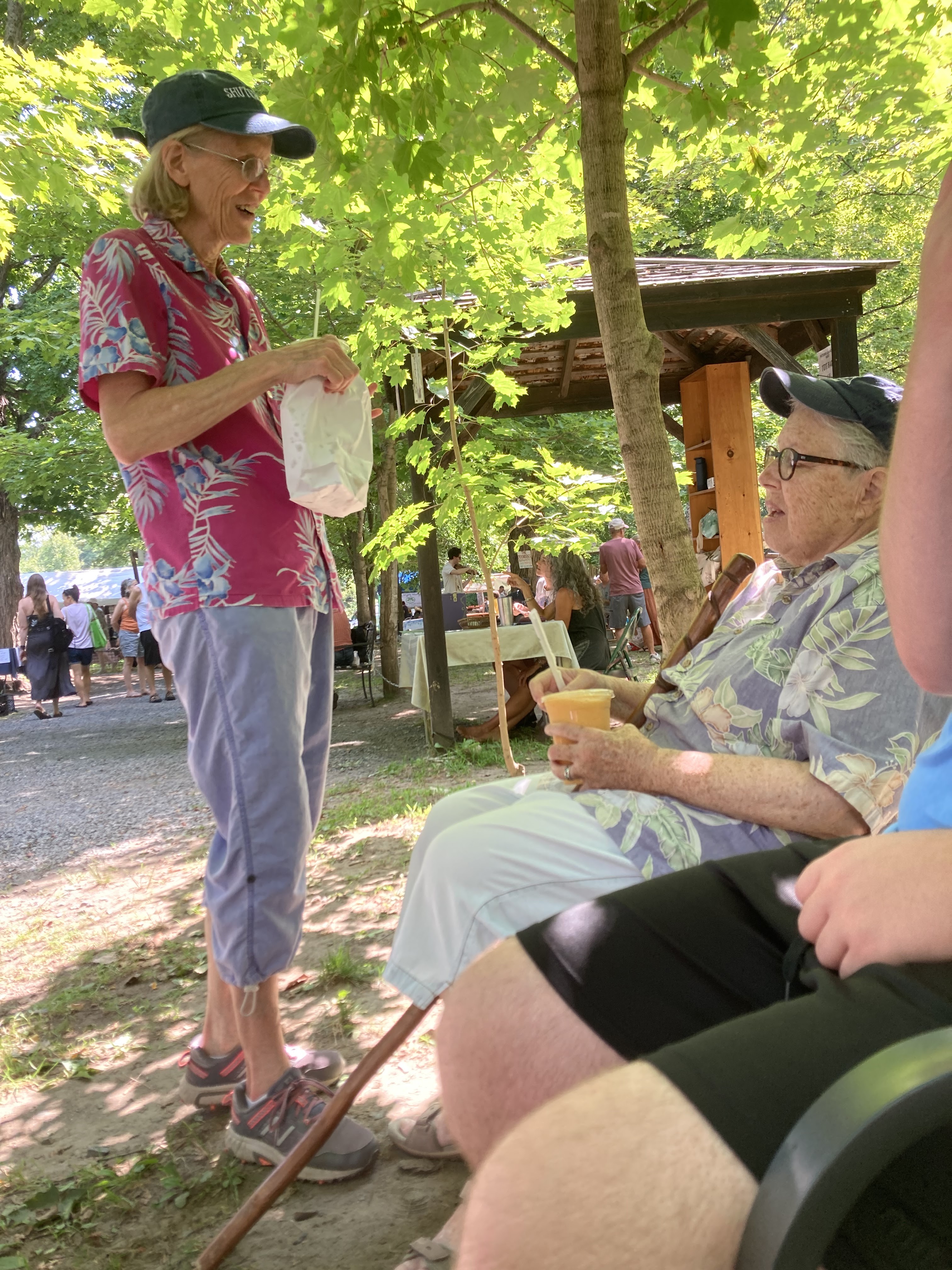
Katie and Savanna. ******************************* There were a lot of people there, but I saw only three I knew, one of whom, Kathleen White, I had not seen and talked with for a long, long time. So that was very nice. Kathleen was the first person to receive the "Unsung Hero" Award in Brattleboro, given by the Brattleboro Area Interfaith Initiative. It was for her 35 years of work as a public nurse, and very well deserved. I used to see her quite often singing with Hallowell and going to the bedside of dying persons to sing - often she would be there also.
Kathleen White, "Unsung Hero." *************************** After spending some time at the Farmer's Market, K,S & B came with us back to the house. It was warm today, but it was fairly pleasant at the house. We had a little snack that Ellen prepared and we had a chance to visit more. Later, I had a visit with John on the phone. I also tried to address a problem we are having with our water system. I think our pressure tank is waterlogged, but I'm not sure. Zach came up with an air pressure tank to see if we could add air to the tank, but I'm not sure I did it right. It didn't help. We may need a new tank. It may be hard to get a plumber to come right away, and we are leaving for Alpine in five days. Right now I am turning the pump off and on manually because the pump just goes and goes and doesn't shut off. I don't want the pump to burn out. John may be able to come over tomorrow and help me - he understands it better than I do, and he has a compressed air tank, which I do not have.

Friday, August 5, 2022

Frank Bridge and more

We are at Marlboro again, listening to Sextet for. Strings, H. 107 by Frank Bridge. Five of the six musicians are women today; Peter Myers, cello, is the sole male. Right now, they are talking things over and playing specific passages that need work.
The musicians performing Bridge's Sextet for Strings.*********************** Who is Frank Bridge? Not a familiar name to me.
Frank Bridge was a teacher of Benjamin Britton, which locates him in time and space. "Frank Bridge, (born Feb. 26, 1879, Brighton, Sussex, Eng.—died Jan. 10, 1941, Eastbourne, Sussex), English composer, viola player, and conductor, one of the most accomplished musicians of his day, known especially for his chamber music and songs. Bridge studied violin at the Royal College of Music, London, but changed to viola, becoming a virtuoso player. After a period in the Joachim Quartet (1906) he played with the English String Quartet until 1915. He also held various positions as a conductor, both symphonic and operatic." I would say from what I have heard so far that he stands in the Late Romantic tradition, but has introduced some new features into his work - like atonality, for example. Ellen remarked that he reminded her of Schoenberg. WE both like the piece very much. It is very lush and complex, but also beautiful. The String Sextet was composed between 1906 and 1912, so Bridge was relatively young - 27 years old - and this was before WW I, which profoundly affected Bridge, who held some pacifist principles. Bridge was sort of forced into being a musician. "His father "ruled the household with a rod of iron", and was insistent that his son spend regular long hours practising the violin; when Frank became sufficiently skilled, he would play with his father's pit bands, conducting in his absence, also arranging music and standing in for other instrumentalists. He studied at the Royal College of Music in London from 1899 to 1903 under Charles Villiers Stanford and others." So I guess he eventually embraced with enthusiasm what he had been forced into doing as a child. I have often wondered just what effect that sort of early coercion has on a person. The musicians in this piece are Cherry Choi Tung Yeung, violin; Isabelle Durrenberger, violin; Hayang Park, viola; Hsin-Yun Huang, viola; Julia Yang, cello; Peter Myers, cello. We have heard three of these before: Peter Myers, Isabelle Durrenberger and Hayang Park. So lets learn something about the others.
Cherry Choi Tung Yeung, violin. "Yeung, from Hong Kong, entered the Curtis Institute of Music in 2019 and studied violin with Ida Kavafian and Arnold Steinhardt; she also studied viola with Steven Tenenbom. Ms. Yeung has performed with the New York Philharmonic; Hong Kong Academy, New World, and Princeton Symphony Orchestras; Symphony in C; and the New Jersey Festival Orchestra. Ms. Yeung served as Concertmaster of The Juilliard School Orchestra and the Curtis Symphony Orchestra where she was awarded the loan of a fine Giovanni Battista Guadagnini violin. Ms. Yeung led the orchestra in the 2020 edition of “Curtis on Tour” and performed in world-renowned venues including Carnegie Hall. Ms. Yeung recently won the position of Associate Principal Second Violin of the San Diego Symphony and will be performing at the Marlboro Music Festival in summer 2022.
Julia Yang, Cello, is praised for “her sense of joyful virtuosity” as concerto soloist (South Florida Classical Review). She is "a courageous and soulful cellist, multi-faceted performer, and founding member of the “riveting” (Reading Eagle) and “impeccably elegant” Merz Trio (All About the Arts)." As a solo cellist, Yang is active as a recitalist and in 2019 was featured as a Young Artist in Residence with Fred Child on Performance Today. Yang has won top prizes at competitions including the Lennox International Competition and the Union League of Chicago’s Young Artist Competition. She has also performed as concerto soloist with the New World Symphony Orchestra, Central Florida Symphony Orchestra, and Northwestern University Symphony Orchestra.
Hsin-Yun Huang, viola. Huang has forged a career as one of the leading violists of her generation, performing on international concert stages, commissioning and recording new works, and nurturing young musicians. Ms. Huang has been soloist with the Berlin Radio Orchestra, the Tokyo Philharmonic, the Bogotá Philharmonic, the NCPA Orchestra in Beijing, Zagreb Soloists, International Contemporary Ensemble, the London Sinfonia, and the Brazil Youth Orchestra, and has performed the complete Hindemith viola concertos with the Taipei City Symphony. She is a regular presence at festivals including Marlboro, Santa Fe, Rome, Spoleto USA, Moritzburg, Music@Menlo, and the Seoul Spring Festival, among many others. She tours extensively with the Brentano String Quartet, most notably including performances of the complete Mozart string quintets at Carnegie Hall. She is currently on the Viola Faculty at the Juilliard School and the Curtis Institute of Music and most grateful for her teachers David Takeno, Peter Norris, Michael Tree and Samuel Rhodes. She is married to Misha Amory, violist of the Brentano String Quartet. They live in New York City and have two children Lucas and Leah. She plays on a 1735 Testore Viola. LATER AFTER A LUNCH BREAK. We are now going to hear again the Brahms Clarinet Quintet, and today we will probably hear it straight through.
The Quintet playing Brahms: Yoonah Kim, clarinet; Isabelle Durrenberger, violin; Brian Hong, violin; En-Chi Cheng, viola; Christoph Richter, cello. There are two musicians that we have not given any background on before: Brian Hong and En-Chi Cheng.
Korean-American violinist Brian Hong has studied at The Juilliard School under the guidance of Laurie Smukler and Donald Weilerstein. He also holds a bachelor’s degree from the New England Conservatory and a master’s from Juilliard, where he was awarded a Kovner Fellowship. As a soloist, he has performed with orchestras such as the Fairfax Symphony Orchestra, Chesapeake Orchestra, US Army Orchestra, National Philharmonic, Springfield Symphony Orchestra, and Juilliard Orchestra, and has won top prizes in many major US competitions. In addition to his many solo achievements, Brian has extensive experience as a chamber musician, having performed at such festivals as the Bowdoin International Music Festival, Music Academy of the West, Taos School of Music, Perlman Music Program, Kneisel Hall, and Yellow Barn. At the New England Conservatory, he studied both classic and contemporary quartet repertoire with mentors such as Laurence Lesser, Kim Kashkashian, Donald Weilerstein, and Lucy Chapman. Highlights of his past seasons include performances of Mendelssohn’s Violin Concerto with Kyle Wiley Pickett and the Springfield Symphony Orchestra, and performances of Schoenberg’s Violin Concerto with Edward Gardner and the Juilliard Orchestra. Brian is a co-artistic director of Nexus Chamber Music Chicago, a collective of vibrant and dynamic musicians who serve to deconstruct the barriers between classical artists and audiences with varied and unique chamber music performances in unconventional venues. As part of his fellowship with Ensemble Connect, Brian teaches at Celia Cruz Bronx High School of Music.
En-Chi Cheng, viola. Taiwanese violist En-Chi Cheng is currently a graduate student of Samuel Rhodes, as a proud recipient of the Kovner Fellowship at The Juilliard School. He earned his Bachelor of Music degree at the Curtis Institute of Music, as a pupil of Joseph de Pasquale and Hsin-Yun Huang. He has also been deeply influenced by the legendary Nobuko Imai, with whom he has worked for the past decade. He is currently the principal viola of the Juilliard Orchestra. Mr. Cheng's recent performance highlights include a solo appearance with the Taipei Symphony Orchestra, playing the Walton Concerto with conductor Felix Chiu-Sen Chen. He also performed as part of the 30th anniversary celebration concert series of the Taiwan National Concert Hall, chamber concert tours led by Nobuko Imai in Taiwan and Japan, and the anniversary gala concert of the Playing for Formosa - one of the most important emerging concert series in Taiwan for young musicians. In addition to sharing music around the world, Mr. Cheng enjoys teaching students both in the United States and Taiwan.**************************************** END OF THE AFTERNOON We got to hear the entire Brahms Clarinet Quintet uninterrupted, and it was incredibly lovely - I think I will rate it my favorite of the summer thus far. I am astounded at how well the clarinet blends with the four stringed instruments. In its lower register, it sounds like a stringed instrument. That may be in part a tribute to the player, Yoonah Kim. In any case, it is a marvelous work, a theme and variations structure that is endlessly creative. It also has an unusual ending on a pianissimo, not a big flourish. Listen to it on YouTube if you can, but it probably won't sound like what we heard today.******************************** We got an email telling us that Jim H had left some groceries from the Guilford Food Pantry for Jerome in the Guilford Church, so we took the beautiful back road through the woods to West Guilford and then over Carpenter Hill Road to Guilford Center, and on to the church, picked up the groceries and delivered them to Jerome. A good day!

Thursday, August 4, 2022

A Little More Marlboro

Today we didn't go to Marlboro early in the day. We waited until Harry had left for home and Ellen made a trip to the landfill. We actually left the house at about 1:30pm real time, maybe a few minutes earlier. We noted the time when we left the covered bridge in order to time the trip to Marlboro via South Newfane on Auger Hole Road. But then we forgot to note the time when we arrived! Phooey! But then, it wasn't the perfect day to time the trip either, because they were grading the road and that slowed us down. Oh well! Anyway, here we are, and they are playing the Beethoven Wind Octet in E-flat Major, Op. 103. Which of course, is very nice to listen to, especially in this delightfully cool hall. Today, we have a whole new set of musicians. Frank Rosenwein, oboe; Russell Hoffman, oboe; Sang Yoon Kim, clarinet; Víctor Díaz Guerra, clarinet; Marlène Ngalissamy, bassoon; Jake Thonis, bassoon; Richard King, horn; Ryan Williamson, horn. Yesterday, the clarinetist in the Brahms Clarinet Quintet was Yoonah Kim, but not today. I think we have heard Victor Diaz Guerra before, but let's look at Sang Yoon Kim. Born in 1987, he is a graduate of the Conservatoire national superieur de musique et de danse in Paris, where he was accepted as the first Korean clarinetist in the school's history. He studied there in the years 2005-2010 with distinguished professors Michel Arrignon and Pascal Moragues. His tuition in Paris was preceded by three years with Florent Heau at the Conservatoire a Rayonnement Regional de Rueil-Malmaison. After Paris he went on to study in Los Angeles at the Colburn Conservatory of Music, gaining an artist diploma under Yehuda Gilad in 2014. He was appointed Principal Clarinet of the Saint Paul Chamber Orchestra in 2018. Sang Yoon is the first prize winner of the 67th Prague Spring International Music Competition 2015. He appeared as a soloist with BBC Symphony Orchestra under the baton of their Music Director, Sakari Oramo at the Prague Spring International Music Festival.
Sang Yoon Kim, clarinet.
Frank Rosenwein plays oboe. He joined The Cleveland Orchestra as principal oboe at the beginning of the 2005–06 season. He made his solo debut with the Orchestra in February 2007, in Bach’s Brandenburg Concerto No. 2. Since then he has performed many times as soloist, including playing the Richard Strauss Oboe Concerto in 2012 and the first Cleveland Orchestra performances of the Vaughan Williams Oboe Concerto in 2017.Since 2006, Mr. Rosenwein has served as head of the oboe department at the Cleveland Institute of Music, where in 2015 he was given the Alumni Achievement award. He also teaches at the Kent Blossom Music Festival, and is in demand as a guest artist and masterclass clinician in schools all over the world. An avid chamber musician, he has spent many summers at the Marlboro Festival and has performed with the Mainly Mozart Festival in San Diego, Philadelphia Chamber Music Society, and the Seattle Chamber Music Society. Born in Evanston, Illinois, Mr. Rosenwein holds a bachelor of music degree from the Cleveland Institute of Music, where he studied with John Mack (Cleveland Orchestra principal oboe, 1965–2001), and a master of music degree from the Juilliard School. Prior to coming to Cleveland, he served as principal oboe (2002–05) of the San Diego Symphony and San Diego Opera. Mr. Rosenwein is married to Cleveland Orchestra associate concertmaster Jung-Min Amy Lee. They live in Cleveland Heights with their twin boys, Joshua and Julian, and their dog, Sofie.***********************
Marlène Ngalissamy plays bassoon. Born in Moscow, Marlene moved to Canada at the age of 10 and began learning the bassoon three years later. She quickly developed a deep passion for the instrument and was accepted at the Montreal Conservatory of Music where she studied with Mathieu Harel and Stephane Levesque. She completed her undergraduate diploma in Montreal and her post-bachelor at the Curtis Institute of music with Daniel Matsukawa. Winner of the first prize in the Canadian Music Competition (2012)and finalist of the Meg Quigley bassoon competition (2015), she performed with the Edmonton Symphony orchestra, the Montreal Metropolitain symphony orchestra, the Montreal Conservatory orchestra and the Youth orchestra of Montreal. She was invited to perform as guest principal bassoon with the Saint-Paul chamber Orchestra and is frequently performing with the Jupiter Chamber Players in New-York. She is also part of a community teaching artist program, working along with Penn memory center, where she is leading a “creativity through music” class for people with diverse stages of Alzheimer’s disease.*********************************** LATER The ensemble playing Beethoven ended their rehearsal early. We are now waiting for the next group, a trio playing Erwin Schulhoff's Concertino for flute, viola and double-bass. Since Schulhoff is not exactly a household name, here is a bit about him:
Erwin Schulhoff (1894-1942) was born in Prague into a German-speaking merchant family. His great-uncle Julius was a composer and pianist, and Erwin's mother hoped her son would follow in his footsteps. The child learned to play the piano, and in 1901 his reputation as a prodigy won him an audition with Antonín Dvorák, who recommended a career in music for the boy. After further private study, Schulhoff was ready for the Prague Conservatory, which he entered in 1904. He also spent an important period in Leipzig, from 1908 to 1910, where he studied at the conservatory with Max Reger, a leading German composer in the post-Brahms tradition, and with Robert Teichmüller, a pianist with a taste for Russian and other exotic eastern music. After four years in the Austrian army during World War I, Schulhoff broke with the late Romanticism espoused by his conservatory teachers. He moved to Dresden, where he met several important artistic figures, including the painter Otto Dix, whose violent, despairing images captured the trauma inflicted by the war, and with them founded the "Werkstatt der Zeit" (Workshop of the Times). Under its banner, Schulhoff began a series of concerts showcasing the latest developments in expressionist music, whose atonal idiom appealed to him as an alternative to what he had learned. He also got to know another painter, George Grosz, and the two listened to records from Grosz' collection of American jazz, another influence embraced by the composer. Following his return to Prague in 1923, Schulhoff began to compose works synthesizing all of these influences - Czech music, Russian and eastern music, late Romanticism, expressionism, and jazz - into a compelling, personal style. Schulhoff wrote the Concertino in a mere four days, between May 28 and June 1, 1925. The first movement begins with bass and violin playing an eastern-sounding motto and the flute offering an improvisatory theme as counterpoint. Schulhoff introduces brief contrasting episodes but always returns to the opening motto. The second movement derives from a Czech folk dance, the furiant, with a rhythm combining characteristics of 2/4 and 3/4. A folk song from the Carpathian Mountains in what is now the western Ukraine provides the basis of the Andante, its melody given to the flute. In the finale, the flutist doubles on piccolo and the bass provides the rhythm for another lively folk dance. After the Germans annexed Czechoslovakia, Schulhoff tried to emigrate to the Soviet Union (he had participated in the International Congress of Revolutionary Musicians in Moscow in 1933 and joined the Communist Party shortly thereafter) and to the West, but without success. The Nazis arrested him in June 1941; he died of tuberculosis in the Bavarian fortress of Wülzburg just over a year later.************************** Here are the musicians who will be playing the Schulhoff Concertino: Joshua Smith, flute; Yuchen Lu, viola; Nina Bernat, double-bass.
The Schulhoff trio on stage.
"Firmly established as one of America’s outstanding flutists, Joshua Smith is equally at home as a soloist, chamber musician, and educator. He was appointed as The Cleveland Orchestra’s principal flute at age twenty, joining the ensemble in 1990. He appears regularly as soloist with the Orchestra, in repertoire ranging from Bach and Mozart to Penderecki and Widmann. In September 2014, he was featured with the Orchestra on tour in Europe, playing Jörg Widmann’s flute concerto at the BBC London Proms, Lucerne Festival, Berlin Philharmonie, Vienna Musikverein, and Amsterdam Concertgebouw. Mr. Smith received a Grammy nomination for his Telarc recording, Air, and has recorded two discs with harpsichordist Jory Vinikour dedicated to the Sonatas of J.S. Bach. He appeared on a Live from the Marlboro Music Festival recording and can be heard on more than 100 Cleveland Orchestra recordings. Mr. Smith appears as a chamber musician throughout the United States, including recent and ongoing appearances with the Philadelphia Chamber Music Society series, at the Marlboro and Santa Fe Music Festivals, and with the Israeli Chamber Project. He has performed in collaborative concerts at the Cleveland Museum of Art, Pensacola Museum of Art, Museum of Contemporary Art in Miami, and the 92nd Street Y in New York City."
"Yuchen Lu, viola. Lu is from Hefei, China), and is currently studying for his BM at New England Conservatory with Kim Kashkashian. Previously, he studied at the Shanghai Music School, where he was principal violist for two years. He won third prize at the Johansen International String Competition, and won the MA-ASTA Solo Competition. Yuchen has attended the Morningside Music Bridge summer festival, and was a member of the National Youth Orchestra of China and the Seiji Ozawa Orchestra Academy."
"Double bassist Nina Bernat is the first prize winner at the 2019 International Society of Bassists Solo Competition and first and grand prize winner of the 2022 Minnesota Orchestra Young Artist Competition. At the age of 19, she performed as guest principal of the Israel Philharmonic under Adrás Schiff and Osmo Vänskä as well as with the New York Philharmonic under Gustavo Dudamel. As a recipient of the 2019 Keston MAX Fellowship, she performed with the London Symphony Orchestra on a subscription series concert at the Barbican Centre and in a chamber music concert for LSO Discovery Day at LSO St. Lukes.   Particularly interested in chamber music, she has performed with the Jupiter Symphony Chamber Players and been a part of Juilliard ChamberFest. Additionally, Nina performed Mozart’s Per Questa Bella Mano with the Juilliard Chamber Orchestra in Alice Tully Hall as winner of the Juilliard Double Bass Competition. Her most recent projects include co-directing the Grace Note Farm Chamber Music Festival, where she shared the stage with violinist Joseph Lin, among others. Nina began studying under the instruction of her father and former member of the Israel Philharmonic, Mark Bernat. She has continued her studies with Tim Cobb and cellist Astrid Schween at the Juilliard School as a proud recipient of the Kovner Fellowship. She has been an invited participant of festivals such as the Verbier Festival Orchestra, Music Academy of the West, Bowdoin International Music Festival, Yellowbarn Young Artists Program, and the New York String Orchestra Seminar. Her 2022 summer plans include a residency at the Grace Note Farm Chamber Music Festival and Marlboro Music Festival." **************** You can't tell clearly from the photo above on stage, but Nina Bernat is about a foot shorter than her double-bass! Whereas Joshua Smith is quite tall, but plays flute and also piccolo.

Wednesday, August 3, 2022

Harry's Accomplishments

Harry always works on projects while he is visiting us. We do not make this a condition, but we are grateful for what he does. This visit, he has worked on several projects. One was that he installed a lamp over the dining table. Last year when he visited, he tried to fix the chandelier over the dining table. It was working, but only partially. He wanted to get it back to its original condition, but was unable to get the parts he needed. In the process, he took it apart and was not able to put it back together. So Ellen advised that he just throw it out. She was not that fond of it anyway. Since then we have been without a light over the dining table. Harry noticed a lamp downstairs. It was one of two lamps we had bought years ago - and I mean years! Maybe like fifteen years! We had bought them to install over the kitchen counter, but for some reason, never did. So all this time they have been sitting in the workroom. He saw them and asked if he could put one of them over the dining table. We thought, "Why not?" So he did. It looks good, and provides a lot of light! Another project was to move the wood that we didn't use last season and stack it next to the door where it will be the first wood we use this fall. It's good and seasoned. Part of it was stacked at the opposite end of the deck, and part of it was still in a pile that never got stacked last fall. So now that is all next to the door. Another project was cleaning up around the stone wall. It was getting overgrown with vines and other weeds, and also covered over by the rhododendron bushes that are above it. So he pulled out stuff and pruned the rhododendron. Now you can see the wall! Another project was cutting up old boards for kindling - he did that last time too, and we still have some of that kindling left to use this year. And now we have more. And i think the pile of old lumber is gone - one less thing Ellen will have to deal with when I'm gone! Another project was the screen door on the sliding doors leading out to the deck. The sliding screen door wouldn't close properly. You had to fiddle with it to get it close completely. He fixed that. It took quite a bit of work to do it - something was interfering with the slide, and he burnished some things, ground something down - I don't know what all. But it works nicely now! And at the moment, he is working on the hood over the range. The light in the hood hasn't worked for a couple of years, and we have used a utility light temporarily in its place. Meanwhile, we bought a new hood, but never got it installed. So Harry is installing it. Wow, that is a lot!
The new light over the dining table.
The wood stacked by the door.
The stone wall cleaned up. The round concrete pillars were supposed to be carted away last year, but Zach never got around to it. Maybe this fall!
Newly cut kindling.
The screen door that now slides smoothly
A work in progress - a new range hood getting installed (you can see the old one (brown) and the new one (white) in the foreground.
Harry - the master problem-solver himself.************************************* LATER
The completed range hood - light off.
Light on.*********************************************** LATER STILL It is now Thursday afternoon. Harry left to return to Philadelphia about an hour ago. Ellen has made a trip to the landfill and we will be heading up to Marlboro pretty soon. It is still pretty nice temperature-wise here at the house but it will be in the 90's by later afternoon. But we'll be in an air-conditioned hall!

Marlboro, Once Again!

Ellen and I are back at the Marlboro Music Festival. We were here last Friday, but did not come Monday or Tuesday of this week. The program this week is a bit smaller because there is no Friday concert, and thus fewer pieces to rehearse. So we will get to hear everything today and tomorrow. It is going to be hot both days - especially tomorrow - so this will be our escape from the heat. Today we will hear a Brahms Clarinet Quintet and a Mendelssohn String Quartet. Two very nice pieces, I am sure. Right now, the musicians in the Brahms Clarinet Quintet in B Minor, Op. 115, are talking amongst themselves. Those musicians are Yoonah Kim, clarinet; Isabelle Durrenberger, violin; Brian Hong, violin; En-Chi Cheng, viola and Christoph Richter, cello. Here they are (fuzzily!):
The Brahms Clarinet Quintet Group (one violist is behind the cellist). ************************* Who are these folks? Let's start with the clarinetist, Yoonah Kim. "Born in Seoul and raised in British Columbia, Yoonah Kim holds a Master of Music degree from The Juilliard School and a Bachelor of Music degree from the Mannes College of Music at The New School, where she studied clarinet under Charles Neidich. She is also currently on the faculty of New York School of Music and Art and maintains a small private studio in New York City. As principal clarinetist of The Juilliard Orchestra and The Mannes Orchestra, Yoonah has performed at prestigious venues, including Carnegie Hall, David Geffen Hall, Alice Tully Hall, and Symphony Space. Rapidly earning recognition as a young artist of uncommon musical depth and versatility, she was, in 2016, the first solo clarinetist to win the Concert Artist Guild competition in nearly 30 years. She has won many other prizes and has performed all over the world."
Yoonah Kim, clarinet.******************************************* We heard the violinist in this ensemble a couple of weeks ago: she is Isabelle Durrenberger,a "rising young artist praised for her vivid musicality, ability to touch audiences, and communicative strength as a chamber musician.  Isabelle is currently completing her graduate studies with Donald Weilerstein and Soovin Kim at the New England Conservatory in Boston. Isabelle will spend the summer of 2022 performing at Perlman Music Program, Marlboro Music Festival, and Lake Champlain Chamber Music Festival. Isabelle’s musical life began at birth; both of her parents are pianists and music educators.  She began playing piano at age 4, but her parents noticed that she loved singing and thought she might enjoy “singing” on the violin — she began lessons at age 7.  Isabelle grew up in Columbus, Ohio, and was extremely lucky to be introduced to Jaime Laredo at age 13.  She attended Meadowmount School of Music for four years, graduated high school a year early, and began her undergraduate program in Cleveland at age 16. She completed her B.M. at the Cleveland Institute of Music where she was mentored by Jaime Laredo.  Her other mentors and influences include Jennifer Koh, Sharon Robinson, Joan Kwuon, Jinjoo Cho, Jan Mark Sloman, and Jun Kim."
Isabelle Durrenberger, violin.************************************** Described in The Times as ‘searching, searing and sublime,’ cellist Christoph Richter performs as soloist and chamber musician throughout the world, with invitations from musicians such as András Schiff, Miriam Fried and Isabelle Faust, festivals including the Salzburg Festival and Marlboro Festival in the US, and composers such as Heinz Holliger and György Kurtág. He was born into a family of musicians and took piano and cello lessons as a child, and when the legendary pedagogue André Navarra heard him play at the age of 15 he invited him to become his youngest ever student.  After graduating with the highest honours he won a state scholarship which enabled him to fulfil a childhood dream to take private lessons with the world-renowned cellist Pierre Fournier, whom he had heard in a recital at the age of 11. He was a prizewinner at international competitions including the Tchaikovsky competition in Moscow, Rostropovich competition in Paris and the Geneva competition, which led to concertos with many leading orchestras. Richter is Professor of cello at the Folkwang University of the Arts in Essen, Germany and the Royal Academy of Music in London. 
Christoph Richter, Cello.**************************************************** LATER Now we are back after a little lunch break sitting on a bench outside in the shade. It is actually very pleasant today - low humidity and not too hot. So we are lucky. We did not get to hear the Brahms played through. They were working on passages that needed attention. What I got to hear was very nice. The clarinetist was astounding. "Uncommon musical depth and versatility" is an understatement. Now, after lunch, a grouo is rehearsing a Mendelssohn String Quartet in E-flat Major, Op. 44, No. 3, with Maria Ioudenitch, violin; Ji Won Song, violin; Hayang Park, viola; Christoph Richter, cello. This piece is not familiar to me. They are also working on passages. I think Wednesdays tend to be that way. They record on Tuesdays and listen, and then work on passages Wednesday.
Quartet playing Mendelssohn. Let's learn a bit about these musicians:
Maria Ioudenitch, violin, was born in Balashov (Russia). She began studying the violin at the age of three with Gregory Sandomirsky, Associate Concertmaster Emeritus of the Kansas City Symphony, and has studied with Ben Sayevich at the International Center for Music at Park University in Parkville, Missouri, since the age of seven. She has participated in various master-classes with such eminent musicians as Midori, Shmuel Ashkenasi, Ana Chumachenco, Zakhar Bron, Pinchas Zukerman, Gil Shaham, Eric Rosenblith and Noah Geller. She appeared in concert as part of The Top NPR Radio Program at Hodgson Hall at the University of Georgia in Athens, Georgia. This presentation was broadcast on national radio in April 2013. In March 2014 Maria took part in the International Music Academy in the Principality of Liechtenstein and spent a week under the tutelage of Ana Chumachenco.She actively contributes in fundraiser activities for the International Center for Music at Park University and for the Knudson Foundation. Maria is now continuing her studies at the Curtis Institute of Music with Shmuel Ashkenasi and Pamela Frank.
Hayang Park, viola. Korean violist Hayang Park was born in Seoul in 1998 and began playing the viola at an early age. From the age of 13 she attended the Yewon School of Arts, of which she is a graduate, and subsequently completed university studies at Yonsei University (South Korea) with Professor Sang-Jin Kim, where she gained a bachelor’s degree in 2019. From 2018 to 2021, she studied at the Escuela Superior de Música Reina Sofía in Madrid with Nobuko Imai, funded by a scholarship from Fundación Albeniz. She has attended masterclasses with Lawrence Power, Tabea Zimmermann, Christoph Poppen and Antoine Tamestit. During her studies in Madrid, she was a member of the Freixenet Symphony Orchestra directed by Péter Eötvös and Pablo González. Since October 2021, she has been studying at Kronberg Academy with Nobuko Imai.
Ji Won Song, violin. Korean violinist Ji Won Song delights audiences worldwide with energetic and engaging performances that express her refined perspectives on melody, color and harmony, as well as her deep passion for her instrument. A versatile soloist and chamber musician, she is sought after for her creative approach, vivid sound, and multi-faceted interpretations of classical and contemporary repertoire. Among the renowned international orchestras with which Ms. Song has soloed include The Philadelphia Orchestra, Shanghai Symphony Orchestra, Bavarian Radio Symphony Orchestra, Montreal Symphony, Belgium National Orchestra, Seoul Philharmonic Orchestra, Incheon Philharmonic Orchestra, Bucheon Philharmonic Orchestra, Korean Symphony Orchestra, Gangnam Symphony Orchestra, and Seongnam Symphony Orchestra. Born in the vibrant city of Seoul, Ji Won Song began formal violin studies at age five with Nam-Yum Kim and Bon-Jiu Koo at the Korean National University of the Arts. She reveled in experimenting with playing techniques and found that the violin’s clear, dynamic voice was an apt vehicle for sharing profound feelings and complex thoughts. At age 10, she emigrated to the United States to study violin at the Cleveland Institute of Music with David Cerone and while studying with him, made her solo debut at the Kennedy Center at age 12. She then studied with renowned violinists Ida Kavafian, Shmuel Ashkenasi and Victor Dachenko at the Curtis Institute of Music, earning her Bachelor’s of Music. Ms. Song then studied with eminent violinists Donald Wilerstein and Soovin Kim at the New England Conservatory of Music, earning her Master’s degree. Ms. Song then graduated from prestigious Artist Diploma program at The Julliard School, and currently pursuing Doctor of Music Arts at the New England Conservatory, where she studies with distinguished violinists Donald Weilerstein and Soovin Kim. Ji Won Song plays the “ex-Curtis” Nicolas Lupot, Paris 1799, generously loaned by a patron through the Tarisio Trust.**************************** Christoph Richter, cello - see above.

Tuesday, August 2, 2022

Sunday's church service

Sunday (July 31st) I led the service in Guilford and preached. I received very positive feedback on the service. I had put a great deal of time into planning the service. Everything was written out in full - the sermon, the children's story, all the prayers and readings. Ellen read the readings: the poem, To Be of Use, by Marge Piercy, Psalm 90, and Matthew 25:14-30. I managed to stand througout the sermon, but I did sit down during the children's story and had a chance to sit during other parts of the service. So I made it through OK and felt very good about it afterward. Some friends watched the service later on YouTube and sent very nice notes about it. The key rext was The Parable of the Talents, Matthew 25:14-30. This is a notoriously difficult parable for many reasons, and it was impossible to go into all that during the sermon because it would have made the sermon too long. So I did something I had never done before - I wrote out four pages of notes on the biblical text and put those notes as an insert into the bulletin. The choir sang a spiritual, Well Done, Servant! I had learned over 25 years ago from Rosita Matthews, who led a gospel choir at Smith College and came to Guilford to lead a gospel sing at a state-wide youth rally we hosted. We learned it orally - no score was handed out - so I had arranged it for 4-part choir back then - and I found that arrangement in the choir archive. That choir piece proved to be very popular with everyone. In the children's story, I brought back two very favorite dolls from the 1990's - Raggedy Ann and Backpack Patty - who were featured in many stories back in that era 25-30 years ago! And it was a special Sunday for me because my first Sunday preaching at the Guilford Church was exactly 60 years ago, the last Sunday in July, 1962! That was not planned - it was an amazing coincidence. So the whole service had sort of a "Wow!" feeling to it.
Giving the children'story
Ellen reading
The choir singing Well Done, Servant!
Delivering the sermon****************************************** Rosita Matthews has a presence online: "Who is Rosita Matthews? National Public Radio called Rosita a "classically trained pianist with a mean gospel rhythm." Rosita has been playing piano since she was five. She directed her first choir at the age of 15. She has performed her infectious music throughout New England, the East Coast and the South. Rosita is a graduate of the University of Michigan in Ann Arbor and Southern Baptist Theological Seminary in Kentucky. She did postgraduate doctoral work at Princeton Theological Seminary in New Jersey. She studied acting in Washington DC and New York City. She appeared in "Malice with Nicole Kidman" and Mario Van Peebles in "The Street Lawyer," a Disney television pilot." When I knew her, she was also a chaplain at the Veteran's Hospital in Holyoke, MA.
Rosita Matthews