Thursday, November 17, 2022
Snow !
Tuesday evening as we were coming home from River Singers it started to snow, and by the time we got home there were pretty heavy flurries. And sure enough Wednesday morning there was an inch or two of snow on the ground or you might say, slush.
 The view out the back door Wed. morning!****************
Wednesday was Dr. appointment, car inspection, and Bible Study. There were some glitches with the transfer to Pastor Elisa as tech person, but basically Bible Study went well as we got more deeply into the relation of John to the Synoptic Gospels. We'll take a break next week for Thanksgiving and meet again Nov. 30th.
Today I'm taking Jerome to the Guilford Food Pantry and this evening we have Hallowell rehearsal.
The view out the back door Wed. morning!****************
Wednesday was Dr. appointment, car inspection, and Bible Study. There were some glitches with the transfer to Pastor Elisa as tech person, but basically Bible Study went well as we got more deeply into the relation of John to the Synoptic Gospels. We'll take a break next week for Thanksgiving and meet again Nov. 30th.
Today I'm taking Jerome to the Guilford Food Pantry and this evening we have Hallowell rehearsal.


Wednesday, November 16, 2022
A visit with the doctor
This morning I had an appointment with Dr. Gilbert Green, my neurologist. His office is in the Gannett Building at Brattleboro Memorial Hospital. (I knew Bob Gannett). I see him every six months. He is monitoring the Parkinson's disease. There was not a lot of change to report, which I guess is good, but we did discuss my shortness of breath and I was able to call his attention to the report of the radiologist on my CT Scan which finally had come into my file. Once again, there was no urgent issue there, but there are things to discuss with my PCP, Dr. van Dyke. The main thing to come out of today is that I should resume the swallowing exercises I got from the speech therapist a year and a half ago or so. I had let them slip. Swallowing is important.
 Dr. Gilbert Green
 Senator Robert Gannett. Bob was a State Senator for 20 years. He also was very active in community affairs and had a lot to do with the establishment of the Long Trail. I knew him mainly as the head of a local foundation that I turned to both when I was raising money for Brattleboro Area Hospice back when I was on their Board of Trustees, and also when the Guilford Church was raising money to pay for the moving and enlarging of the church building back in the 1990's. As someone said, he was "the consummate gentleman."
 The Gannett Medical Office Building.
After that appointment, we got some bagels and came down to Richmond Auto in Guilford for a State inspection of the impreza. That all went well and now we are at the Guilford Church waiting for Bible Study.
The Gannett Medical Office Building.
After that appointment, we got some bagels and came down to Richmond Auto in Guilford for a State inspection of the impreza. That all went well and now we are at the Guilford Church waiting for Bible Study.


Tuesday, November 15, 2022
Happy Birthday, Ellen!
Today is Ellen's 80th birthday! It is hard to believe! She carries her age very beautifully. We had a lovely lunch today at Burdick's restaurant in Walpole, NH - a very nice restaursant which we understand is owned partly by Ken Burns. (It's true - he's been a part-owner since 2001 and eats there several times a week). An item on the menu today was "Ken's Salad," which he "invented," ate "off-menu" for years, and now it is on-menu and very popular. Katie Tolles ordered it today. It features grilled salmon, Bibb letttuce and avacado. I had "Mussells Mariniere." They said they came from Prince Edward Island. Ellen had a platter of mixed vegetables, which she said were very tasty. Savanna had a "huge" burger. We all enjoyed what we ordered. It was just a very nice treat.
 My most recent photo of Ellen - the Bible Study Group yesterday. Ellen is top row, second from left.
 Ellen's vegetable platter
 My mussells
 Savanna and Katie - with burger and Ken's Salad
 Burdick's restaurant- their photo.
 Burdick's restaurant - my photo.


Sunday, November 13, 2022
Catching up
I haven't been very disciplined about reporting on what we've done recently, or posting photos I've taken. The everyday sort of thing. So let's go back to last Thursday. I got an email from my friend, Phil McKean, which had a link to a memorial service that was held for Deborah McKean out in California, at Pilgrim Place, a retirement community in Claremont, CA that was created originally for United Church of Christ retired missionaries, clergy and academics. I don't think it is exclusively for such people but they may get preference for finding a place there. Phil and Deborah fit that profile - Phil is a retired UCC minister and they both were missionaries in Indonesia back in the 1960's; Phil is also a retired college professor - he taught for a few years at Hampshire College in Massachusetts. Phil and Deborah have had an apartment at Pilgrim Place for quite a few years, but during the pandemic, when they wanted to fly from their summer home in Maine back to Clarement, and there was an airline policy requiring masks, Deborah's Alheimer's condition made that impossible - she could not tolerate wearing a mask, and could not understand why she had to. So they stayed in Maine, she went into a nursing home in Camden, ME, and that is where she died last April. There was a memorial service for her in September - see the post for September 25th - but now Phil has gone back to Clarement, and since friends there had not had the opportunity to honor her life, they held a service there in a lovely Japanese garden which is on the grounds of Pilgrim Place. So I watched the video, and it was very moving to see and hear my godson, Tom, sing once again (he lives in California), to see and hear Phil again, and also get to "meet" their friends at Pilgrim.Place, which, by the way, Ellen and I Visited on one of our many trips a decade or so ago, soon after the McKeans moved there, so it not an entirely strange place for me. Their daughter, Susannah, was not able to be there, but some of Phil's extended family - relatives of his sister - were there and participated in the service. The big surprise for me was to see Rev. Ron Evans in the service. Ron served the church in Deerfield, MA - about 30 miles south of Brattleboro, Vermont on Route 5 - back in the 1970's, and he filled the pulpit at the Guilford Community Church just before Shirley became the minister there in 1976. So I knew Ron, and did not know (or did not remember!) that he was at Pilgrim Place or was a friend of the McKeans. But there he was, giving the sermon at Deborah's memorial service, and I caught him in a screen shot. He's looking good!
 Rev. Ron Evans. ******************************
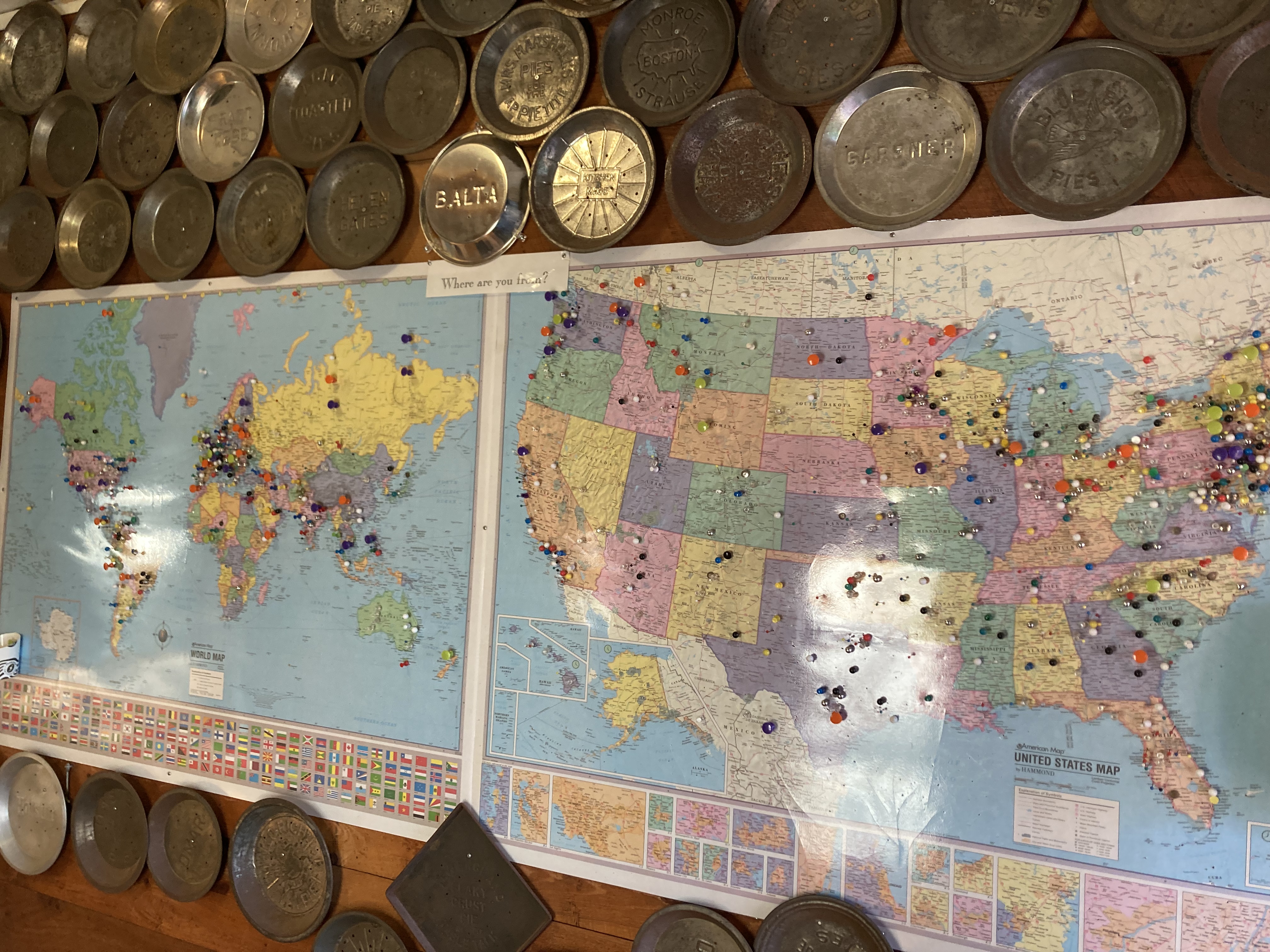
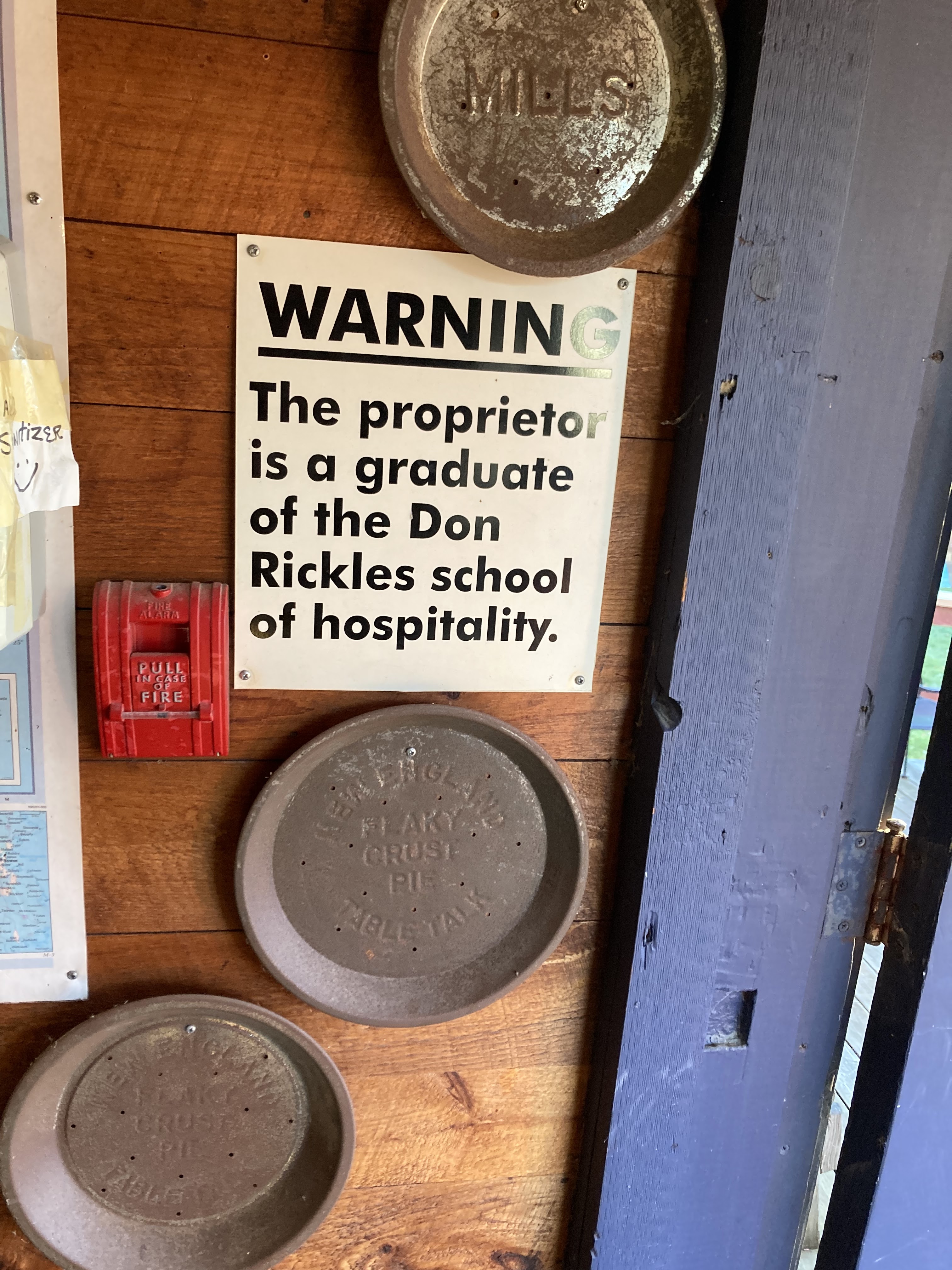
Later on Thursday, Ellen and I made our little trip to Grandma Miller's Bakery, where they have the Morninglory Muffins that I love, and on Thursday they make a special bakery treat - chocolate eclairs. So we try to go on Thursdays. I went in amd got a photo of the entry hall - sort of unusual - a big world map which allows visitors to put a push pin into their home town - people obviously come there from all over the world! The wall around the map is covered with vintage pie tins. It's a unique spot. And in the midst, a funny sign - see below. When we got home, I took a picture of our entryway at the house where Ellen had put the bouquet she had made for the altar at the Guilford Church a week ago - still looking very nice surrounded by colorful gourds.
Rev. Ron Evans. ******************************
Later on Thursday, Ellen and I made our little trip to Grandma Miller's Bakery, where they have the Morninglory Muffins that I love, and on Thursday they make a special bakery treat - chocolate eclairs. So we try to go on Thursdays. I went in amd got a photo of the entry hall - sort of unusual - a big world map which allows visitors to put a push pin into their home town - people obviously come there from all over the world! The wall around the map is covered with vintage pie tins. It's a unique spot. And in the midst, a funny sign - see below. When we got home, I took a picture of our entryway at the house where Ellen had put the bouquet she had made for the altar at the Guilford Church a week ago - still looking very nice surrounded by colorful gourds.
 House entryway.
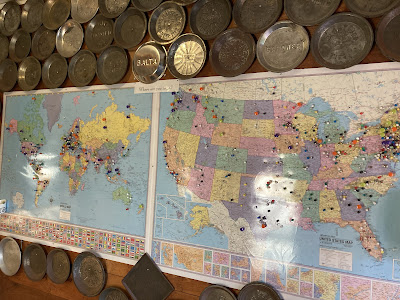 Visitor home towns map at Grandma Miller's Bakery
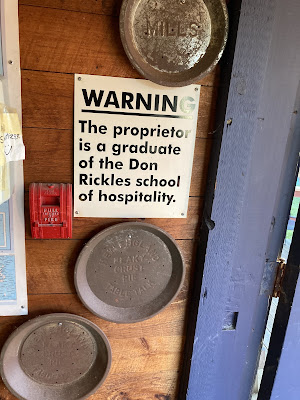 Don Rickles is, of course, a comedian specializing in "insult" comedy.
 That delicious eclair!
And then Saturday night, we went to a birthday party for Robin Davis - and sort of for Ellen too, because she and Robin share a birthday - which was at the home of their son, Arthur, and his wife, Emma (they were just married a couple of weeks ago. That was fun because we had never been inside their home before. It is an older home in a nice neighborhood in Brattleboro which they were able to buy just before house prices went crazy. The meal was great - they had a baked ham from Rebop Farm where Arthur works occasionally, sweet potatoes, two salads, and Ellen brought a spinich pie. Emma had made an almond flour pie with blueberry filling which was delicious. Nice home, nice people, nice meal, nice time.
And then today was the Windham-Union Association meeting after another very lovely service in Guilford, another life story, this time told by Carole Crompton. Every one of these stories is very special. But then, what would would one expect? We are all unique.
That delicious eclair!
And then Saturday night, we went to a birthday party for Robin Davis - and sort of for Ellen too, because she and Robin share a birthday - which was at the home of their son, Arthur, and his wife, Emma (they were just married a couple of weeks ago. That was fun because we had never been inside their home before. It is an older home in a nice neighborhood in Brattleboro which they were able to buy just before house prices went crazy. The meal was great - they had a baked ham from Rebop Farm where Arthur works occasionally, sweet potatoes, two salads, and Ellen brought a spinich pie. Emma had made an almond flour pie with blueberry filling which was delicious. Nice home, nice people, nice meal, nice time.
And then today was the Windham-Union Association meeting after another very lovely service in Guilford, another life story, this time told by Carole Crompton. Every one of these stories is very special. But then, what would would one expect? We are all unique.
 Robin and Ellen contemplating their cake.
 Arthur and Emma Davis




Windham-Union Association Meeting
At the moment, I am sitting in the Dummerston Congregational Church, Waiting for the Association meeting to begin at 3p.m. Here is the sanctuary:
 There will hopedfully be about a dozen churches represented here today, celebrating the 225th Anniversary of the formation of the Association back in 1797, an event which took place in this very church. I will be giving a talk about the history behind that event, something which I researched back in 1997 when I was writing the history of the Guilford Church and ran across a copy of the minutes of that first organizational meeting, tucked into an old Guilford Church record book - the only copy in existence, to my knowledge. If I hadn't found it, we wouldn't know the details about that first meeting.
LATER
It was a good meeting. We had the dozen churches, and 21 people - one more than needed for a quorum! Not a huge turnout, but a very appreciative one. Our quartet (Ellen, ELiza, Shawn and myself, did a stirring rendition of AFRICA, a shape-note hymn by Issac Watts (words) and William Billings (music), and I was able to tell the story of Elijah Wollage, the Guilford Church, and the formation of the Consociation of the Churches of Christ of Windham County, Oct. 3, 1797 - the first organization of churches in the state of Vermont. People were very engaged and I got a huge positive response.
There will hopedfully be about a dozen churches represented here today, celebrating the 225th Anniversary of the formation of the Association back in 1797, an event which took place in this very church. I will be giving a talk about the history behind that event, something which I researched back in 1997 when I was writing the history of the Guilford Church and ran across a copy of the minutes of that first organizational meeting, tucked into an old Guilford Church record book - the only copy in existence, to my knowledge. If I hadn't found it, we wouldn't know the details about that first meeting.
LATER
It was a good meeting. We had the dozen churches, and 21 people - one more than needed for a quorum! Not a huge turnout, but a very appreciative one. Our quartet (Ellen, ELiza, Shawn and myself, did a stirring rendition of AFRICA, a shape-note hymn by Issac Watts (words) and William Billings (music), and I was able to tell the story of Elijah Wollage, the Guilford Church, and the formation of the Consociation of the Churches of Christ of Windham County, Oct. 3, 1797 - the first organization of churches in the state of Vermont. People were very engaged and I got a huge positive response.
 Giving my talk at the Association Meeting.
 The quartet singing AFRICA. I know, there are only three of us in this photo. Shawn Bracebridge is off-camera to the left.****************************
Here is the story of the formation of the Windham Consociation:
ELIJAH WOLLAGE AND THE FORMATION OF THE WINDHAM CONSOCIATION
We. are celebrating today the 225th anniversary of the formation of this Association which took place in the Dummerston Congregational Church on October 3, 1797. It was not called the Windham-Union Association at that time. It was called the Consociation of the Churches of Christ in Windham County. That organization later became the Windham-Union Association when churches in southern Windsor County were added - churches such as Springfield, Weathersfield, Perkinsville, Ludlow and Tyson were added to those in Windham County. Unfortunately, at this moment, I do not know exactly when that happened.
We need to realize that in 1797 there were no County or State organizations of churches in Vermont as such. A Ministerial Association had been formed in Windham County as early as October, 1775 - the first such organization in the state, and then, 20 years later, on August 27, 1795, the General Convention of Ministers in the State of Vermont was formed in the study of the President of Dartmouth College, Ebenezer Wheelock. Membership in that ministerial Convention was opened to laymen in 1823. and the Vermont Domestic Missionary Society was formed in 1823 as well. In 1841, the General Convention of Ministers changed its name to become the Convention of Ministers and Churches. So a State Conference sort of evolved over time.
But the Consociation of the Churches of Christ in Windham County.was the first organization of Churches in the state of Vermont. I think we can take some note of that, and we might ask, why was this Association (Or Consociation, as it was called) why was it formed at that time? We can begin to find an answer to that question, I think, in the minutes of the founding meeting and the By-laws of the newly formed consociation contained in them. We are very fortunate to actually have these minutes and by-laws. I believe I am right in saying that they were not preserved in the records of the Association, the State Conference Archives, or even in the Congregational Library in Boston. But someone had slipped a loose copy of these minutes - actually a transcript of the original which no longer exists - into the oldest record book of the Guilford Congregational Church (a.k.a. the Guilford Community Church) and that is where I found them back in 1997 when I was researching my history of the Guilford Church, titled Safe Thus Far, which was published in 1999. And when I studied them, and took note of the timing of the formation of the Consociation, and correlated that date with what was happening in the Guilford Church at that time, I fashioned a theory as to why the Consociation was formed - it was formed, I believe, in response to what was regarded as an unfortunate occurrence in the relationship between the Guilford Church and its pastor, the Rev. Elijah Wollage.
Elijah Wollage came to the Guilford Church officially in 1793, but had been preaching there for some time before. He had been born in nearby Bernardston, MA, and thus undoubtedly knew of the Guilford Church and may have been known by the Guilford Church for some time. He had graduated from Dartmouth College in 1791 at age 22 - and might have started preaching soon after his graduation. He was probably also newly married, having married Sally Babcock of Westmoreland, N.H. The records state that on the same day, March 12th, 1793, the church met to call Wollage as a settled pastor, and an Ecclesiastical Council met immediately after that meeting to confirm that call. Then, the very next day, Wollage was ordained! That was what we today would call a rush job! It was also a bit cozy: Ministers from Bernardston, his home town, and Westmoreland, his wife's home town, sat on his Ecclesiastical Council, and the ordination sermon was given by his wife's home pastor, the Rev. Ethan Pratt. Wollage had a very active pastoral ministry in his first 2-3 years at the Guilford Church. The church records show that he baptized 79 infants and adults, admitted 35 new members, performed 35 marriages, and presided over 27 funerals, including 13 infants and children and seven young women! But that activity slacked off rapidly a year or so before he suddenly left the church.
Something led to a hastily called and improper dismissal of Wollage on April 11, 1797, four years after his arrival.. David Stowell, deacon and clerk, wrote at that time in the record that a meeting was held in the home of Doctor Deeney Hyde with the Rev. Bunker Gay, pastor of the church in “Hinds Dale” (N.H.) serving as Moderator, at which it was agreed unanimously by both Wollage and the Church that he be dismissed and that “his Relation of Pastor of the Aforesaid Church and Society is from this time henceforth and forever to be Considered as Void and of none Effect.” Sort of an extreme way of putting a dismissal.
What was going on? The church records are silent as to reasons, but we have another source! A prominent citizen of Guilford at that time was the honorable Royall Tyler, a jurist who would later become the Chief Justice of the Vermont Supreme Court, and a playwright, author of The Contrast, considered the first comedy written in the U.S. His wife, Mary, would write a memoir, Grandmother Tyler's Book, and that memoir is full of information, one might even say gossip, about none other than -- Elijah Wollage!
One has to take Mary Tyler's account with a grain of salt, but the substance is undoubtedly accurate. Elijah Wollage's wife, according to Mary, was very unhappy because the church did not pay him enough. He was paid in both cash and produce, a notoriously problematic procedure. Mary Tyler quotes Sally Wollage as saying to her, “When (Royall) comes home he brings you pretty things and gets money; but we delve and delve, and find it hard work to get our four hundred dollars at last, although we have to take it in anything, at their own prices. Oh, you can’t tell how trying it is.” If Mary Tyler is to be believed, Sally pressured her husband to find a more remunerative career, and at some point he gave in and secretly went to Royall Tyler and began reading for the law. This probably explains the rapid drop in his pastoral ministry - he was busy studying to be a lawyer! And his wife couldn't keep her mouth shut, and word got out, the congregation was incensed, and he was summarily dismissed. - His departure rivals and perhaps exceeds the questions about a lack of proper procedure that his hurried call and ordination raised.
With Wollage in mind, certain sections of the Consociation minutes jump off the page. Take section 7:
"vii. As a means of preventing hasty and premature proceedings among ourselves; of obviating those suspicions & jealousies of misconduct, which might otherwise arise in the minds of sister churches; & to convince them them that we mean to walk orderly, as the disciples of Christ, that our mutual fellowship may not be broken; we will not consent to the dismission of any Minister who has been regularly settled among us, without calling an ecclesiastical council to advise & assist us in a matter so weighty, in which the edification of particular churches, & the interest of religion in general are so deeply interested. "- So, in other words, a church could not dismiss their minister without the Churches of the Association. coming together, looking into the situation, and giving their approval!
Or this:
vi. As it appears from the directions given to Timothy and Titus that they hath made his Ministers judges of the qualifications of those who are to be introduced into the work of the gospel ministry (2 Timothy 2.2 Titus 1, etc.) & as we wish not to encourage any who go not forth orderly to the work, therefore when destitute of settled Pastors we will not employ any candidate for the gospel Ministry but such as come recommended from some known body of Ministers. "
Clearly, the ministers and laymen gathered on October 3, 1797, just six months after Wollage's dismissal, were concerned about church-minister relations, and believed that the churches, though the structure and procedures of a Consociation, had the right and duty to provide oversight in both the call and dismissal of a minister. I just can't help but think they when they wrote these by-laws, they had Elijah Wollage in mind.
If we had the time, it would be interesting to have a discussion about how we feel about all this oversight. Maybe at some future time we can do that. I don't know whether, as time went on, the Association actually put these principles into practice. We actually need a history of the Association. But whoever attempted to write such a history would face a daunting task - finding records. Some early ones are in the Congregational Library. But many, perhaps most, are missing. The Association has seemed never to have had a central and safe archive for its records. It has never, to my knowledge, faithfully preserved its records. So let me end with a plea:
I think we should make a concerted effort to find and preserve all Association records we can still lay our hands on. Start with what all known Moderators and Registrars/Scribes still living might still have in their homes or on their computers. Perhaps we should even ask the children of those who are no longer living what they might have.. Perhaps there are local Church records which have Association records tucked in with them - like the Guilford Church had the minutes of that first meeting tucked into an old record book. I think those records are worth saving, and someone, someday, may surface who will be inspired to write a history of the Windham-Union Association. the first organization of churches in the state of Vermont.
Let me add a P.S., an epilog. Elijah Wollage came back to Guilford. Seven years later, Jan 4, 1804, “at the request of Mr. Elijah Wollage . . . now attorney at Law, the Church and Society met at the house of Dr. Dana Hyde in Guilford when the said Mr. Wollage appeared and verbally confessed many imprudences in his conduct towards said Chh. & Society in special his great precipitancy in asking a dismission and hastily quitting them to their Damage & asked their forgiveness when that of the Chh. present retired by themselves. Voted to forgive said Mr. Wollage as a Brother & member of said Church.”
Then a year later, he showed up again and asked the church to request the Association to call an Ecclesiastical Council to redo his dismissal in a regular way, which it eventually did in 1805. But even that isn't the end. Wollage gave up his trial career as a lawyer, and came back to Guilford in 1811 after the ministry of Jason Chamberlain and resumed his role as pastor, though not as an officially settled minister. Two things happened during that second ministry which must have been discouraging for Wollage:- a church was built in East Guilford which eventually became the first Episcopal Church in Vermont, Christ Church, and drew ten members away from the Congregational Church in Guilford Center. And then in 1818, his twelve-year-old son George drowned after diving into Broad Brook. Wollage left Guilford later that year he went to Rockingham and was pastor for three years there, and then he went to Western New York, where he worked at various positions, and during which time his daughter, Cerintha, married Joel Pratt. He died in 1847, and is buried in Rock Stream, NY in Yates County, just a few miles from where I lived in the late 1960's, when I was on the faculty of Keuka College. And in 1998 I found two descendants of his, George C. Pratt in East Norwich, NY and, amazingly, Elijah Wollage Pratt in Salt Lake City, Such are the fascinations and rewards of being a church historian.
Thank you.
The quartet singing AFRICA. I know, there are only three of us in this photo. Shawn Bracebridge is off-camera to the left.****************************
Here is the story of the formation of the Windham Consociation:
ELIJAH WOLLAGE AND THE FORMATION OF THE WINDHAM CONSOCIATION
We. are celebrating today the 225th anniversary of the formation of this Association which took place in the Dummerston Congregational Church on October 3, 1797. It was not called the Windham-Union Association at that time. It was called the Consociation of the Churches of Christ in Windham County. That organization later became the Windham-Union Association when churches in southern Windsor County were added - churches such as Springfield, Weathersfield, Perkinsville, Ludlow and Tyson were added to those in Windham County. Unfortunately, at this moment, I do not know exactly when that happened.
We need to realize that in 1797 there were no County or State organizations of churches in Vermont as such. A Ministerial Association had been formed in Windham County as early as October, 1775 - the first such organization in the state, and then, 20 years later, on August 27, 1795, the General Convention of Ministers in the State of Vermont was formed in the study of the President of Dartmouth College, Ebenezer Wheelock. Membership in that ministerial Convention was opened to laymen in 1823. and the Vermont Domestic Missionary Society was formed in 1823 as well. In 1841, the General Convention of Ministers changed its name to become the Convention of Ministers and Churches. So a State Conference sort of evolved over time.
But the Consociation of the Churches of Christ in Windham County.was the first organization of Churches in the state of Vermont. I think we can take some note of that, and we might ask, why was this Association (Or Consociation, as it was called) why was it formed at that time? We can begin to find an answer to that question, I think, in the minutes of the founding meeting and the By-laws of the newly formed consociation contained in them. We are very fortunate to actually have these minutes and by-laws. I believe I am right in saying that they were not preserved in the records of the Association, the State Conference Archives, or even in the Congregational Library in Boston. But someone had slipped a loose copy of these minutes - actually a transcript of the original which no longer exists - into the oldest record book of the Guilford Congregational Church (a.k.a. the Guilford Community Church) and that is where I found them back in 1997 when I was researching my history of the Guilford Church, titled Safe Thus Far, which was published in 1999. And when I studied them, and took note of the timing of the formation of the Consociation, and correlated that date with what was happening in the Guilford Church at that time, I fashioned a theory as to why the Consociation was formed - it was formed, I believe, in response to what was regarded as an unfortunate occurrence in the relationship between the Guilford Church and its pastor, the Rev. Elijah Wollage.
Elijah Wollage came to the Guilford Church officially in 1793, but had been preaching there for some time before. He had been born in nearby Bernardston, MA, and thus undoubtedly knew of the Guilford Church and may have been known by the Guilford Church for some time. He had graduated from Dartmouth College in 1791 at age 22 - and might have started preaching soon after his graduation. He was probably also newly married, having married Sally Babcock of Westmoreland, N.H. The records state that on the same day, March 12th, 1793, the church met to call Wollage as a settled pastor, and an Ecclesiastical Council met immediately after that meeting to confirm that call. Then, the very next day, Wollage was ordained! That was what we today would call a rush job! It was also a bit cozy: Ministers from Bernardston, his home town, and Westmoreland, his wife's home town, sat on his Ecclesiastical Council, and the ordination sermon was given by his wife's home pastor, the Rev. Ethan Pratt. Wollage had a very active pastoral ministry in his first 2-3 years at the Guilford Church. The church records show that he baptized 79 infants and adults, admitted 35 new members, performed 35 marriages, and presided over 27 funerals, including 13 infants and children and seven young women! But that activity slacked off rapidly a year or so before he suddenly left the church.
Something led to a hastily called and improper dismissal of Wollage on April 11, 1797, four years after his arrival.. David Stowell, deacon and clerk, wrote at that time in the record that a meeting was held in the home of Doctor Deeney Hyde with the Rev. Bunker Gay, pastor of the church in “Hinds Dale” (N.H.) serving as Moderator, at which it was agreed unanimously by both Wollage and the Church that he be dismissed and that “his Relation of Pastor of the Aforesaid Church and Society is from this time henceforth and forever to be Considered as Void and of none Effect.” Sort of an extreme way of putting a dismissal.
What was going on? The church records are silent as to reasons, but we have another source! A prominent citizen of Guilford at that time was the honorable Royall Tyler, a jurist who would later become the Chief Justice of the Vermont Supreme Court, and a playwright, author of The Contrast, considered the first comedy written in the U.S. His wife, Mary, would write a memoir, Grandmother Tyler's Book, and that memoir is full of information, one might even say gossip, about none other than -- Elijah Wollage!
One has to take Mary Tyler's account with a grain of salt, but the substance is undoubtedly accurate. Elijah Wollage's wife, according to Mary, was very unhappy because the church did not pay him enough. He was paid in both cash and produce, a notoriously problematic procedure. Mary Tyler quotes Sally Wollage as saying to her, “When (Royall) comes home he brings you pretty things and gets money; but we delve and delve, and find it hard work to get our four hundred dollars at last, although we have to take it in anything, at their own prices. Oh, you can’t tell how trying it is.” If Mary Tyler is to be believed, Sally pressured her husband to find a more remunerative career, and at some point he gave in and secretly went to Royall Tyler and began reading for the law. This probably explains the rapid drop in his pastoral ministry - he was busy studying to be a lawyer! And his wife couldn't keep her mouth shut, and word got out, the congregation was incensed, and he was summarily dismissed. - His departure rivals and perhaps exceeds the questions about a lack of proper procedure that his hurried call and ordination raised.
With Wollage in mind, certain sections of the Consociation minutes jump off the page. Take section 7:
"vii. As a means of preventing hasty and premature proceedings among ourselves; of obviating those suspicions & jealousies of misconduct, which might otherwise arise in the minds of sister churches; & to convince them them that we mean to walk orderly, as the disciples of Christ, that our mutual fellowship may not be broken; we will not consent to the dismission of any Minister who has been regularly settled among us, without calling an ecclesiastical council to advise & assist us in a matter so weighty, in which the edification of particular churches, & the interest of religion in general are so deeply interested. "- So, in other words, a church could not dismiss their minister without the Churches of the Association. coming together, looking into the situation, and giving their approval!
Or this:
vi. As it appears from the directions given to Timothy and Titus that they hath made his Ministers judges of the qualifications of those who are to be introduced into the work of the gospel ministry (2 Timothy 2.2 Titus 1, etc.) & as we wish not to encourage any who go not forth orderly to the work, therefore when destitute of settled Pastors we will not employ any candidate for the gospel Ministry but such as come recommended from some known body of Ministers. "
Clearly, the ministers and laymen gathered on October 3, 1797, just six months after Wollage's dismissal, were concerned about church-minister relations, and believed that the churches, though the structure and procedures of a Consociation, had the right and duty to provide oversight in both the call and dismissal of a minister. I just can't help but think they when they wrote these by-laws, they had Elijah Wollage in mind.
If we had the time, it would be interesting to have a discussion about how we feel about all this oversight. Maybe at some future time we can do that. I don't know whether, as time went on, the Association actually put these principles into practice. We actually need a history of the Association. But whoever attempted to write such a history would face a daunting task - finding records. Some early ones are in the Congregational Library. But many, perhaps most, are missing. The Association has seemed never to have had a central and safe archive for its records. It has never, to my knowledge, faithfully preserved its records. So let me end with a plea:
I think we should make a concerted effort to find and preserve all Association records we can still lay our hands on. Start with what all known Moderators and Registrars/Scribes still living might still have in their homes or on their computers. Perhaps we should even ask the children of those who are no longer living what they might have.. Perhaps there are local Church records which have Association records tucked in with them - like the Guilford Church had the minutes of that first meeting tucked into an old record book. I think those records are worth saving, and someone, someday, may surface who will be inspired to write a history of the Windham-Union Association. the first organization of churches in the state of Vermont.
Let me add a P.S., an epilog. Elijah Wollage came back to Guilford. Seven years later, Jan 4, 1804, “at the request of Mr. Elijah Wollage . . . now attorney at Law, the Church and Society met at the house of Dr. Dana Hyde in Guilford when the said Mr. Wollage appeared and verbally confessed many imprudences in his conduct towards said Chh. & Society in special his great precipitancy in asking a dismission and hastily quitting them to their Damage & asked their forgiveness when that of the Chh. present retired by themselves. Voted to forgive said Mr. Wollage as a Brother & member of said Church.”
Then a year later, he showed up again and asked the church to request the Association to call an Ecclesiastical Council to redo his dismissal in a regular way, which it eventually did in 1805. But even that isn't the end. Wollage gave up his trial career as a lawyer, and came back to Guilford in 1811 after the ministry of Jason Chamberlain and resumed his role as pastor, though not as an officially settled minister. Two things happened during that second ministry which must have been discouraging for Wollage:- a church was built in East Guilford which eventually became the first Episcopal Church in Vermont, Christ Church, and drew ten members away from the Congregational Church in Guilford Center. And then in 1818, his twelve-year-old son George drowned after diving into Broad Brook. Wollage left Guilford later that year he went to Rockingham and was pastor for three years there, and then he went to Western New York, where he worked at various positions, and during which time his daughter, Cerintha, married Joel Pratt. He died in 1847, and is buried in Rock Stream, NY in Yates County, just a few miles from where I lived in the late 1960's, when I was on the faculty of Keuka College. And in 1998 I found two descendants of his, George C. Pratt in East Norwich, NY and, amazingly, Elijah Wollage Pratt in Salt Lake City, Such are the fascinations and rewards of being a church historian.
Thank you.
 Judge George C. Pratt, retired federal judge in the 2nd District; a descendant of the Rev. Elijah Wollage.


Wednesday, November 9, 2022
Showing up
One often hears that one of the best things you can do sometimes is just show up. I think I had that proved last Sunday. I was supposed to be at First Congregational Church for the final Sunday of the Reverend Audrey Walker. I was supposed to represent her fellow clergy's support for her and read a farewell liturgy. She was not leaving of her own volition. The church had asked her to leave. She was obviously not happy about that, although I think she also recognized that it was an opportunity for her to find fuller fulfillment of her skills somewhere else. I had sent her several emails telling her that I would be coming and what time I would be arriving, none of which she received. Meanwhile she had called me on my cell phone several times and never received an answer and had left a voicemail message which I never heard or saw. I guess you could call it a comedy of errors. The day before I was supposed to be there, we finally made contact, and she had to regretfully tell me that she had decided I wasn't coming and had made arrangements to have my role filled by someone else. We both felt very badly about this, but I certainly respected her decision and we ended the call with the expectation that I would not be there the next day. But the more I thought about it, the more I felt that I should be there. There was no reason why I couldn't just go and be a part of the congregation and indicate to anybody who asked that I was there to be supportive of Audrey and also of the church. So I went. And it was so good that I did. Audrey was very appreciative that I was there and I had a chance to speak with people about why I was there and got a lot of appreciation for my being there from members of the congregation. And when it came time for the liturgy of farewell that I was supposed to do originally, Audrey invited me up and I just sat with the group as a sort of presence. I showed up. It was a lovely service, and I think my being there had a healing effect both for Audrey and the church. And I felt good too.
 Audrey and me after church at the coffee hour.

Friday, November 4, 2022
Figures from my Bible Study Class
We had the second session of the Bible Study Group last Wednesday afternoon. It went well, I think. I got some very gratifying feedback on it. E.g., one person wrote, "I can’t tell you how thrilling this class is (and I never thought I’d use that word in reference to Bible Study!). I am so grateful you are doing this." I did some things this week I didn't do the first session - as I get more used to Zoom. One was to do "screen share." That involved putting things up on the computer screen that everyone could see. Mostly what I put up was written material that I had people read aloud. But I have some pictures that I intended to put up too - I'll put them up here to give you an idea of some things we are talking about.
Here is a photo of Brian McLaren:
 Brian McLaren is a "Progressive" Christian who has recently published book titled Do I Stay Christian? We read this book for a book study group at the Guilford Church - several members of that group are also in Bible Study. I think you could say that it was their urging that I do Bible Study that got me "off the dime," so to speak and actually get a group going. One of his main points is that if one decides to continue to identify as a Christian today, one must rethink what that means in today's world. One cannot just coast along in the old habits and old language that characterized Christianity a few decades ago. That effort to rethink our faith in the light of urgent contemporary issues is at least part of my purpose in doing this class. So he is sort of "looking over my shoulder" as I move through this course.
Another contemporary figure who many of us read on an almost daily basis is Fr. Richard Rohr, who is a Franciscan monk and head of the Center for Action and Contemplation in New Mexico. He sends out a daily meditation which is always very insightful. He has written some things about the Gospel of John, which is our current topic of study, which I will be using in the course. Here is his photo:
Brian McLaren is a "Progressive" Christian who has recently published book titled Do I Stay Christian? We read this book for a book study group at the Guilford Church - several members of that group are also in Bible Study. I think you could say that it was their urging that I do Bible Study that got me "off the dime," so to speak and actually get a group going. One of his main points is that if one decides to continue to identify as a Christian today, one must rethink what that means in today's world. One cannot just coast along in the old habits and old language that characterized Christianity a few decades ago. That effort to rethink our faith in the light of urgent contemporary issues is at least part of my purpose in doing this class. So he is sort of "looking over my shoulder" as I move through this course.
Another contemporary figure who many of us read on an almost daily basis is Fr. Richard Rohr, who is a Franciscan monk and head of the Center for Action and Contemplation in New Mexico. He sends out a daily meditation which is always very insightful. He has written some things about the Gospel of John, which is our current topic of study, which I will be using in the course. Here is his photo:
 Fr. Richard Rohr.***************
One of the tools I use in my own preparation for this course is a Greek-English Lexicon, the Liddell-Scott Unabridged Lexicon, which is a hefty tome. It is an amazing product of nineteenth-century British scholarship on the Greek language - done long before the age of computers when everything was done on note cards. I presume that hundreds of scholars were involved in reading literally thousands of Greek texts from the ancient world, spanning centuries, and recording the use of Greek words and their meaning in a variety of contexts. So for example, the article on the Greek word "Logos," which occurs in the first verse of the Gospel of John ("In the Beginning was the Logos, and the Logos was with God and the Logos was God"), fills over six columns in the Liddell-Scott Lexicon, with hundreds of examples of its use and the variety of meanings it might have. Here is the title page from Liddell-Scott:
Fr. Richard Rohr.***************
One of the tools I use in my own preparation for this course is a Greek-English Lexicon, the Liddell-Scott Unabridged Lexicon, which is a hefty tome. It is an amazing product of nineteenth-century British scholarship on the Greek language - done long before the age of computers when everything was done on note cards. I presume that hundreds of scholars were involved in reading literally thousands of Greek texts from the ancient world, spanning centuries, and recording the use of Greek words and their meaning in a variety of contexts. So for example, the article on the Greek word "Logos," which occurs in the first verse of the Gospel of John ("In the Beginning was the Logos, and the Logos was with God and the Logos was God"), fills over six columns in the Liddell-Scott Lexicon, with hundreds of examples of its use and the variety of meanings it might have. Here is the title page from Liddell-Scott:
 And here is a page from the article on the word "Logos":
 The first page of the article on "Logos" in Liddell-Scott.****************
The massive work was edited by Henry George Liddell, an Oxford don. I cannot imagine what it meant for him to edit this work. I think it is beyond imagining. I also don't really know how much of the work was done by Scott, and how they divided it. I don't think there can be much doubt that it took over their lives for years, and perhaps decades. Here is Liddell's portrait:
The first page of the article on "Logos" in Liddell-Scott.****************
The massive work was edited by Henry George Liddell, an Oxford don. I cannot imagine what it meant for him to edit this work. I think it is beyond imagining. I also don't really know how much of the work was done by Scott, and how they divided it. I don't think there can be much doubt that it took over their lives for years, and perhaps decades. Here is Liddell's portrait:
 Henry George Liddell.*********************
He looks as though he could be pretty demanding - but then you would have to be to get a work like that Lexicon finished. However, he had a daughter, Alice, for whom Lewis Carroll wrote Alice in Wonderland. Maybe he had a gentler side.
I also want to mention one last thing - it has personal significance. I have a Bible in my library called The Bible: An American Translation. It is not widely known. It belonged to my father.
Henry George Liddell.*********************
He looks as though he could be pretty demanding - but then you would have to be to get a work like that Lexicon finished. However, he had a daughter, Alice, for whom Lewis Carroll wrote Alice in Wonderland. Maybe he had a gentler side.
I also want to mention one last thing - it has personal significance. I have a Bible in my library called The Bible: An American Translation. It is not widely known. It belonged to my father.
 An American Translation of the Bible. Sort of the worse for wear, but then, so am I! We are about the same age. *******************
It was created by J. M. Powis Smith, who edited the translation of the Old Testament and translated much of it himself, and by Edgar Goodspeed, who translated the entire New Testament himself. It was published by the University of Chicago Press, at about the time my father was a student at Chicago Theological Seminary (c. 1930). He had both Smith and Goodspeed as teachers, I think.
An American Translation of the Bible. Sort of the worse for wear, but then, so am I! We are about the same age. *******************
It was created by J. M. Powis Smith, who edited the translation of the Old Testament and translated much of it himself, and by Edgar Goodspeed, who translated the entire New Testament himself. It was published by the University of Chicago Press, at about the time my father was a student at Chicago Theological Seminary (c. 1930). He had both Smith and Goodspeed as teachers, I think.
 J. M. Powis Smith, Hebraist. **********************
There are many autographs inside both the front and back covers of this Bible - most of them I think are my father's fellow students. He must have collected them. Some are of faculty - at the top of one page is the autograph of J.M. Powis Smith.
J. M. Powis Smith, Hebraist. **********************
There are many autographs inside both the front and back covers of this Bible - most of them I think are my father's fellow students. He must have collected them. Some are of faculty - at the top of one page is the autograph of J.M. Powis Smith.
 J.M.Powis Smith's autograph at the top of the page.*******************
I don't see Edgar Goodspeed's autograph anywhere, but his is a name very familiar to me, not least because he also wrote a book called The Junior Bible, a translation, or you might better say a paraphrase, of the Bible written especially for young people, and my father gave that Bible to me when I was about eight years old, and it was my introduction to the Bible. Here is a portrait of Edgar Goodspeed - a very attractive man, I would say:
J.M.Powis Smith's autograph at the top of the page.*******************
I don't see Edgar Goodspeed's autograph anywhere, but his is a name very familiar to me, not least because he also wrote a book called The Junior Bible, a translation, or you might better say a paraphrase, of the Bible written especially for young people, and my father gave that Bible to me when I was about eight years old, and it was my introduction to the Bible. Here is a portrait of Edgar Goodspeed - a very attractive man, I would say:
 Edgar J. Goodspeed, New Testament Scholar and Translator.


Subscribe to:
Posts (Atom)